The Othered Mind: Representing Autism in Criminal Minds
Isabel Hay, University of Bristol, Film and Theatre BA, Year 2
Politics of Performance, summative essay, awarded 78/100 first class.
The portrayal of autism in popular media is a subject of growing attention, with a considerable proliferation of autism stereotypes emerging since the 1990s (Draaisma, 2009, p.1476). Autism Spectrum Disorder is a neurological disorder characterised by challenges in social-emotional reciprocity, nonverbal communication, and the development of relationships. It involves restricted and repetitive behaviours such as repetitive movements or speech, a preference for routine, intensely focused interests, and sensory sensitivities (American Psychiatric Association, 2013). Autism also forms a diverse social group of individuals (Prochnow, 2014, p.133), many of whom advocate for the neurodiversity paradigm which challenges the pathologisation of neurological difference and instead frames it as valuable part of human diversity (Freeman Loftis, 2015, pp.4–5). Although some literature uses the terms ‘mental illness’ and ‘disorder’ interchangeably, I reject the equation of autism and mental illness. However, I recognise that such scholarship can provide useful insights into the representations of neurological disabilities. For this reason, I will be substituting ‘illness’ with ‘disorder’ in this essay.
Criminal Minds (2005-present) is police procedural crime drama following a team of FBI profilers who investigate serial killers referred to ‘unsubs.’ While praised for its compelling narratives and character development, Criminal Minds has also faced criticism for its pathologisation of neurological conditions. Much of the existing scholarship on neurodiversity in Criminal Minds focuses on the autistic-coding of Spencer Reid (Matthew Gray Gubler). However, considerably less attention has been given to the implications of Reid’s ambiguous portrayal and the potential harm arising from the depiction of neurodiverse antagonists. This gap in research warrants deeper analysis of how Criminal Minds represents autism, and how these portrayals shape public understanding of neurodivergence. In this essay, I argue that the representation of autism in media, exemplified by Criminal Minds, reflects a broader cultural trajectory in which neurodivergent individuals are erased, stereotyped and denied agency. This reveals a need for more responsible, inclusive, and nuanced portrayals of autism that challenge dominant regimes of representation.
Seclusion, Stereotypes and Symbolic Power in Media
Representation of subordinate groups in media often follows a predictable trajectory, beginning with neglect or erasure which reinforces their absence in broader cultural narratives. Institutional mechanisms like censorship have contributed to this. Gerbner’s (1959, pp.294-295) study showed that before 1951, films depicting mental disorder were routinely censored. By 1958, there was a rise in portrayals, but they were still disproportionately rejected (p.298). While network censors discouraged careless use of mental disorder for dramatic effect, critiqued remained. One journalist criticised that psychotics had come to replace traditional villains (p.303). Although intended to protect, censorship often silences authentic narratives.
This cultural neglect mirrors the historical lack of academic interest in disability studies. Charlton (1998, p.8) describes the oppression of disabled individuals as a ‘human rights tragedy’ which has only recently begun to be recognised and resisted. However, mental disabilities remain underrepresented in this field (Freeman Loftis, 2015, pp.14; 154, Charlton, 1998, p.17). Scholars (Borecky, 2019, p.111; Johnson and Olson, 2021, p.89) note that while some identity groups have received increased media, activist, and academic attention, neurodiversity remains largely overlooked. This creates a cultural blind spot that reflects and reinforces the marginalisation of autistic individuals. Despite growing public interest in autism, more work is needed on media ‘performances that represent life on the spectrum’ (Freeman Loftis, 2015, p.13, p.153).
Marginalised identities, when first represented, are often depicted in ways that reinforce existing societal prejudices. As portrayals become more positive, they lack dimension and accuracy. Stuart Hall (1997, p.258) defines these stereotypes as the reduction of a group’s diversity and complexity into simplistic, reductive images or ideas. His constructionist approach (p.15) argues that meaning is not reflected but actively constructed through cultural codes and language, corroborated by Dyer (1999) who suggest that stereotypes appear to reflect social consensus, but our perception often stems from the stereotypes themselves. This regime of representation shows how stereotypes exert symbolic power by fixing, naturalising and stigmatising difference (Hall, 1997, pp.258-259), often through binary and polarised portrayals (p.229). Though nuanced portrayals have emerged, progress is uneven across social groups. Television often fails to show autism as a spectrum disorder, presenting ‘little range in characters’ behaviours, mannerisms, and intellectual levels’ (Prochnow 2014, p.136). Strategies like transcoding can challenge dominant stereotypes by offering positive images, however, they often fail to dismantle the deeper structures that frame them (Hall, 1997, p.270). Despite this, it is important to deconstruct representational codes that define autistic people as Other.
Constructing the Dangerous Other in Criminal Minds and Beyond
Spivak’s framework of othering explores how power operates through representation (Jensen, 2011, p.64). Othering is the process by which dominant groups construct subordinate groups (ibid., p.65), creating boundaries between ‘us’ and ‘them’ (Lister, 2003, p.101). The power to define both the self and the Other lies with the centre, which reinforces its own legitimacy by assigning inferiority to the margin (Jensen, 2011, pp.63–65). In this framework, neurotypicality occupies the centre, and neurodivergence the margin. The Other is rendered invisible, defined only by their difference (hooks, 2014, p.370), and often reduced to stereotypical, dehumanised representations (Lister, 2004, p.102). This is evident in Criminal Minds, which supports Johnson and Olson’s (2021, p.69) suggestion that the portrayal of mental disorders tends to be factually inaccurate and highlights negative attributes.
Borecky argues that Criminal Minds links mental disorder with serial violence, exploiting societal fears surrounding mental health and reinforcing the perspective that neurodivergent individuals are dangerous and should be institutionalised or eliminated (2019, pp.iv, 55, 98). This othering is demonstrated in ‘To Hell…’ ‘…And Back’(2009), where the antagonists are depicted as monsters. Lucas (Paul Rae), a mentally disabled man, is manipulated by his quadriplegic brother, Mason, into abducting and murdering victims as part of a medical experiment. Lucas is portrayed as cognitively impaired and violent, initially communicating only through animalistic grunts before speaking in limited, childish language. Rae’s performance evokes both autistic-coded traits, such as eye contact avoidance and self-soothing rocking, and dehumanising, animalistic behaviours unrelated to autism, reinforcing a distorted image of the disorder. Mason dehumanises Lucas, calling him “crazy,” “inhumanly strong,” and a psychotic killer. Reid’s speculation that Lucas may be autistic or have “moderate mental retardation” anchors his behaviour to recognisable diagnoses. Freeman Loftis (2015, p.10) argues that popular media misinterprets autistic communication styles as a lack of empathy, falsely linking autism to violence, despite the diagnostic criteria not including empathy deficits (American Psychiatric Association, 2013). Although the episode briefly elicits sympathy for Lucas when he breaks down after being called a “freak,” this is eclipsed by the episode’s bleak resolution where both brothers are killed. The episode reduces neurodivergence to horror, reinforcing ableist tropes and showing how media depictions can perpetuate stigma under the guise of dramatic storytelling.
The process of othering extends beyond fiction into real-world journalism, where neurotypical media producers shape public discourse. A study on British newspaper coverage of autism (Beattie et al., 2022) found a continued negative bias. This is evident in the news coverage of to the Sandy Hook shooting which focused on the perpetrator’s neurodivergence, despite no evidence linking autism to violent crime (Fournier, 2012; The Interagency Autism Coordinating Committee, 2012). Autistic individuals we feared to become collateral damage of this irresponsible media coverage (Fournier, 2012), with a survey showing 30% of parents worried their children would be treated differently in the aftermath (Rochman, 2012). This demonstrates real-life othering, where the media defines the autistic community through a lens of negativity, furthering their marginalisation.
Charlton (1998, p.50) argues that mass media acts as ‘milieu and a medium of domination and subordination,’ reflecting and reproducing the dominant culture’s values. Television portrayals of mental disorders significantly influence societal attitudes, and when these portrayals are negative or inaccurate, they contribute to misconceptions about autism (Draaisma, 2009, p.1479; Johnson and Olson, 2021, p.70). Cultural ignorance stems not from malice, but from a lack of necessity to be aware of alternative perspectives. For those without personal experience of autism, media becomes their primary source of understanding (Freeman Loftis, 2015, p.15). As a passive medium, television allows individuals to absorb information unintentionally (Dutta-Bergman, 2004, p.278), which can create lasting and harmful perceptions ‘based solely on stereotypical media representations’ (Johnson and Olson, 2021, p.69, 89). These perpetuate the othering of autistic individuals and reinforce societal ignorance and systems of exclusion. To address this, it is essential that autistic communities are included in cultural conversations and represented authentically and responsibly.
The Unlabelled and Unclaimed Neurodivergence of Spencer Reid
Popular media often implies autistic traits in characters without confirming autism within the narrative (Babar, 2023; Johnson and Olson, 2021, p.87; Prochnow, 2014, p.137). Spencer Reid is frequently interpreted as autistic-coded, particularly in online fan forums (Reddit, 2022). However, the in the show’s eighteen seasons this is never confirmed. The only clear suggestion of autism comes from an unsub (‘Broken Mirror’, 2005), placing the narrative authority in the hands of the antagonist, thereby framing it in a negative light. Behind the scenes, the Reid’s neurodivergence is more clearly recognised; casting directors specifically sought an actor capable of portraying an autistic-coded character, and Gubler himself believes Reid is autistic (O’Neal, 2013, p.131). Reid’s performance occupies a liminal space, where it subtly influences representations of autism yet remains unacknowledged by the authoritative narrative.
Reid embodies the savant (Prochnow, 2014, p.137), an autistic archetype defined by extreme cognitive abilities, framing autism as a special gift which makes the individual more intriguing rather than a disability. Reid is depicted as an extraordinary problem-solver as demonstrated when he solves a complex code longhand (‘The Angel Maker’, 2008). This prompts Prentiss to joke, “He’s so lifelike,” adhering to the computer-like metaphor often applied to autistic individuals which Draaisma (2009, p.1479) suggests perpetuates the myth that autistic people have no feelings. While Reid subverts stereotypes through his recognition of non-verbal cues and ability to connect with people involved in cases, particularly with those with disabilities like in ‘Coda’ (2011), he struggles with romantic and social interactions outside of a professional framework. In ‘Somebody’s Watching’ (2006), he fails to recognise Lila’s romantic advances, and in ‘52 Pickup’ (2008), he is flustered and surprised by a bartender’s interest. Morgan frequently teases Reid about his social awkwardness despite his nickname ‘pretty boy’. Additionally, Reid’s struggles with charismatic communication, evident during a lecture when Rossi’s (Joe Mantegna) jokes elicit laughter while Reid’s fall flat (‘Masterpiece’, 2008). These moments highlight the divide between Reid’s intellectual brilliance and social difficulties, reinforcing his savant status while maintaining his otherness compared to his neurotypical colleagues.
Murray (2008) suggests the savant archetype neutralises the discomfort around autistic representation by framing ‘the unknown in a manner that generates no fear or unease’. Criminal Minds’ reluctance to label Reid as autistic, while openly pathologizing antagonists, reveals a double standard in media representation. As Osteen (2010, p.33) argues, autistic characters are portrayed as either ‘geniuses or freaks,’ never ordinary people. Labels are used when they contribute to fear, suspense, or drama, but withheld when it would demand sensitivity, realism, or advocacy. Similarly, creators of The Big Bang Theory and Bones incorporated autistic-coded characters without labelling, fearing the responsibility of accurate depiction and potential audience alienation (Alan, 2010). Freeman Loftis (2015, p.4) suggests that atypical characters are fascinating because of their otherness. By leaving Reid’s diagnosis ambiguous, creators benefit from this intrigue whilst avoiding the ethical responsibility of representation. Reid’s neurodivergence is suggested and mythologised, but not claimed nor understood, sustaining a cultural regime that positions the neurotypical as the unspoken norm, an ‘insidious sort of social inequality’ (Walker, 2013). As Johnson and Olson (2021, p.10) emphasises, accurate portrayals are essential for inclusion and education, as they challenge prevailing ideas of normal thinking. Progress requires more than the inclusion of neurodivergent characters; it demands nuanced storytelling that names and normalises autistic experiences.
From Puzzle to Person: The Struggle for Autistic Agency in ‘Coda’
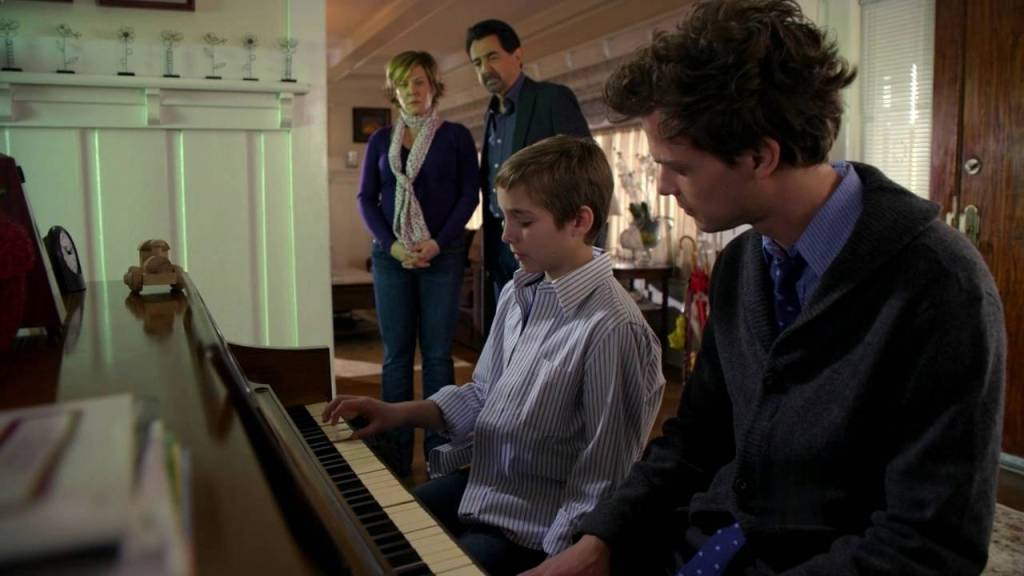
Joe Mantegna (2011), who has an autistic daughter, advocated for an episode of Criminal Minds where autism was ‘correctly portrayed.’ While what constitutes a correct portrayal is subjective, Mantegna’s involvement highlights the value of including those with personal experience in developing autistic narratives. The episode, ‘Coda’, was generally well received with an IMDb (2025) rating of 8.1. However, even in seemingly progressive portrayals, troubling patterns persist. Sammy Sparks (Skyler Brigmann), a nonverbal autistic boy, plays a crucial role in solving his parents’ kidnapping but communicates primarily through music and drawing. With the unsub revealed to the audience early in the episode, the focus is on the team interpreting Sammy’s clues. Despite the sensitivity shown to Sammy’s communication style, he is ultimately denied agency, serving as a narrative device to drive the plot. This highlights a broader issue of autistic characters being visible but voiceless.
Sammy’s portrayal reinforces the stereotype that low-masking autism is the default expression of the condition. Bridgman’s performance emphasises stereotypical markers, such as a meltdown triggered by physical contact, which includes dramatic vocalisations, convulsing in a high tension state, and repetitive rocking. Bridgman avoids eye contact, appears emotionally vacant with a slack jaw, and exhibits pronounced stimming behaviours. Sammy demonstrates the tendency for fictional characters to represent autistic individuals who display more severe neurodivergent traits. This contributes to high-masking autism, which is especially prevalent among females (Carracedo, 2020), being overlooked, reflecting the wider issue of female autism being under-researched and underrepresented (Chester, 2019; Nordahl, 2023). Autism is a syndrome spectrum defined by a continuum of severity and a variety of traits (Strate, 2006, p112). Such repeated representation oversimplifies the autistic spectrum, treating it as linear rather than recognising autism as highly individual and characterised by a dynamic intersection of traits and differences. Scholars emphasise that although it is difficult to represent the whole of the spectrum, it is important to try (Johnson and Olson, 2021, p.89; Prochnow, 2014, p.133). Without doing this, the media’s narrow focus creates a distorted view of what neurodiversity looks like in real life. As viewers are exposed to exaggerated representations, it leads to a lack of understanding and awareness of the more subtle or varied ways that neurodivergence can manifest, thus it becomes harder for people to recognise neurodivergence in real life, as explained by Ferguson (2016) who said her family does not recognise her neurodivergence as it doesn’t look like what they see on television. This can contribute to a lack of acceptance and understanding of autistic people, reinforcing misconceptions and perpetuating stigma.
Draaisma (2009, p.1477) observes a binary in portrayals of autism, where characters have either diminished or superhuman capacity. Criminal Minds reflects this: the unsub is portrayed with impaired moral capacity, Reid embodies exaggerated brilliance, and Sammy blends both tropes. However, despite his savant-like piano skills, Sammy is primarily framed by deficit, particularly through his mutism. Though initially positioned as a central character, the narrative denies Sammy subjectivity and agency. Sammy fails to embody the ‘novelistic character’ (Dyer, 1999) with inner depth, and remains a static ‘type’ defined solely by autism. He lacks interiority and personal or emotional depth, serving as a puzzle for the neurotypical team to decode. This reflects a regime of representation in which autistic individuals are cast as Other. Freeman Loftis (2015, p.4) argues that autistic characters are often treated as enigmas, fascinating for their otherness but ultimately objectified as puzzles rather than people. This is evident in ‘Coda’ where the reveal of Sammy’s autism just before the opening credits positions autism as a dramatic twist, reinforcing a spectacle of otherness.
Sammy also reflects characteristics of the Subaltern (Spivak, 1988), a marginalised identity so excluded from dominant discourse that they ‘cannot speak’ (p.104). For the Subaltern to be heard, their voice is often translated into the language of the dominant group, mirrored in how Sammy must be interpreted through neurotypical logic. This reflects broader societal expectations for autistic individuals to mask or adapt, rather than be accepted as they are. Additionally, Reid explains early in the episode Sammy cannot return his mother’s hug, setting up an emotional arc that culminates in Sammy accepting a hug in the episode’s denouement. Though framed as progress, the scene upholds a neurotypical ideal, implying Sammy’s worth depends on conforming to normative behaviour rather than embracing neurodivergent communication. Milton (2019) argues that neurocognitive functioning is culturally constructed, while Freeman Loftis (2015, pp.5–6) promotes a social disability model, framing disability as valuable human diversity rendered problematic by an unaccommodating society. ‘Coda’ exemplifies how even sympathetic portrayals can reinforce exclusion by offering visibility without granting genuine voice or agency.
Redefining Difference in Popular Culture
In conclusion, Criminal Minds reflects a pattern of neurodivergence through extremes, either as gifted geniuses or dangerous outsiders, which reinforce damaging stereotypes and other autistic people from the ‘normal’ group. The consequences of this miseducation include social alienation, internalised stigma and barriers to support for autistic individuals. To move forward, media must embrace more authentic, nuanced portrayals of autism. Such representation not only empowers neurodivergent viewers but also positively influences social attitudes by building empathy and normalising diverse ways of being.
To insist on narrow, stereotypical representations is to flatten the complexity of human experience into sameness. Just as media can misinform, it also has the power to educate and dismantle prejudice. Autism does not exist in binaries or along a linear spectrum, but within a multidimensional array of traits and experiences. Accurately reflecting this demands diverse, informed, and purposeful storytelling because who is seen is just as important as how they are seen. The Disability Rights Movement’s slogan ‘Nothing About Us Without Us’ (Charlton, 1998; United Nations, 2004) calls for self-representation which means including autistic voices throughout the creative process of media production. In doing so, we embrace all forms of diversity, including cognitive diversity, and encourage alternative epistemologies to reconstruct our ‘hegemonic… picture of social reality’ (Mills, 1988, p.239). As Audre Lorde (1984) reminds us; it is not our differences that divide us, but our failure to recognise, accept, and celebrate those differences. By reframing difference as a source of strength, we pave the way for a richer, more inclusive world for everyone.
Bibliography
’52 Pickup’ (2011) Criminal Minds, series 4, episode 9. CBS. Available at: Disney+ (Accessed: 5 May 2008).
Alan, S. (2010). How TV Shows Try (or Choose Not) to Depict Asperger’s Syndrome. [online]. Nj. Available at: https://www.nj.com/entertainment/tv/2010/02/how_tv_shows_try_or_choose_not.html.
American Psychiatric Association (2013). DSM-5 TM Guidebook: The Essential companion to the Diagnostic and Statistical Manual of Mental Disorders. 5th ed. Washington: Dc American Psychiatric Publishing.
‘… And Back’ (2009) Criminal Minds, series 4, episode 25. CBS. Available at: Disney+ [Accessed 5 May 2025].
Babar, I. (2023). How Authentic is Neurodivergent Media Representation? [online] Neurodiverse Connection. Available at: https://ndconnection.co.uk/blog/neurodivergent-media-representation.
Beattie, G., Gabrielatos, C., Karaminis, T. and Maden-Weinberger, U. (2022). Portrayals of autism in the British press: A corpus-based study. Autism, 27(4), pp.1092–1114. Available at: https://doi.org/10.1177/13623613221131752.
Borecky, A. J. (2019). Music and the Monster: Sounding Fear and Mental Illness in Criminal Minds. [online] Available at: https://trace.tennessee.edu/utk_gradthes/5459/ [Accessed 29 Apr. 2025].
‘Broken Mirror’ (2005) Criminal Minds, series 1, episode 5. CBS. Available at: Disney+ [Accessed 5 May 2025].
Carracedo, A., Cruz, S., Fernández-Prieto, M., Sampaio, A. and Tubío-Fungueiriño, M. (2020). Social Camouflaging in Females with Autism Spectrum Disorder: A Systematic Review. Journal of Autism and Developmental Disorders, [online] 51(7). Available at: https://doi.org/10.1007/s10803-020-04695-x.
Charlton, J.I. (1998). Nothing About Us Without Us: Disability Oppression and Empowerment. California: University of California Press. Available at: https://www.jstor.org/stable/10.1525/j.ctt1pnqn9
Chester, V. (2019). Autistic Women and Girls: Under-recognised, Under-researched and Under-served. Advances in Autism, [online] 5(1). Available at: https://doi.org/10.1108/aia-01-2019-049.
‘Coda’ (2011) Criminal Minds, series 6, episode 16. CBS. Available at: Disney+ [Accessed 5 May 2025].
Criminal Minds (2005-present) CBA. Available at: Disney+ [Accessed 5 May 2025]
Draaisma, D. (2009). Stereotypes of Autism. Philosophical Transactions of the Royal Society B: Biological Sciences, 364(1522), pp.1475–1480. Available at: https://doi.org/10.1098/rstb.2008.0324.
Dutta-Bergman, M.J. (2004). Primary Sources of Health Information: Comparisons in the Domain of Health Attitudes, Health Cognitions, and Health Behaviors. Health Communication, 16(3), pp.273–288. Available at: https://doi.org/10.1207/s15327027hc1603_1.
Dyer, R. (1999). The Role of Stereotypes. In: Media Studies: A Reader 2nd Edition. Edinburgh University Press.
Ferguson, S. (2016). I’m Mentally Ill, and I Love Crime Shows Like Criminal Minds – Even Though They’re Dangerously Ableist – WYV Archive. [online] WYV Archive. Available at: https://wyvarchive.com/mentally-ill-criminal-minds/ [Accessed 2 May 2025].
Fournier, W. (2012). Statement From the National Autism Association | Sandy Hook – National Autism Association. [online] National Autism Association – Providing real help and hope for the autism community since 2003. Available at: https://nationalautismassociation.org/sandyhook/ [Accessed 26 Apr. 2025].
Freeman Loftis, S. (2015). Imagining Autism: Fiction and Stereotypes on the Spectrum. Bloomington: Indiana University Press.
Gerbner, G. (1959). Mental illness on television: A study of Censorship. Journal of Broadcasting, 3(4), 293–303. Available at: https://doi.org/10.1080/08838155909385890
Grieve, J. (2022). UK Press Attitudes Towards Autism Skew Negative, New Study Finds | EHU. [online] Edge Hill University. Available at: https://www.edgehill.ac.uk/news/2022/11/representations-of-autism-in-the-national-british-press/ [Accessed 5 May 2025].
Hall, S. (1997). Representation: Cultural Representation and Signifying Practices. London: Sage.
hooks, b. (2014). Eating the Other: Desire and Resistance. 2nd ed. Routledge. Available at: https://doi.org/10.4324/9781315743226-3
IMDb (2025). ‘Criminal Minds’ Coda (TV Episode 2011) – Ratings – IMDb. [online] IMDb. Available at: https://www.imdb.com/title/tt1835074/ratings/?ref_=tt_ov_rat [Accessed 5 May 2025].
Jensen, S.Q. (2011). Othering, Identity Formation and Agency. Qualitative Studies, 2(2), pp.63–78. Available at: https://doi.org/10.7146/qs.v2i2.5510.
Johnson, M.A. and Olson, C.J. (2021). Normalizing Mental Illness and Neurodiversity in Entertainment Media: Quieting the Madness. [online] London: Routledge. Available at: https://doi.org/10.4324/9781003011668
Lister, R. (2004). Poverty. Cambridge: Polity Press.
Lorde, A. (1984). The Master’s Tools Will Never Dismantle the Master’s House. In: Sister Outsider: Essays and Speeches. Berkeley, California: The Crossing Press.
‘Masterpiece’ (2008) Criminal Minds, series 4, episode 8. CBS. Available at: Disney+ [Accessed 5 May 2025].
Milton, D.E.M. (2019). Disagreeing over Neurodiversity. Psychologist, 32(8).
Mills, C. W. (1988). ‘Alternative Epistemologies’, Social Theory and Practice, 14(3), pp. 237–263. Available at: http://www.jstor.org/stable/23557047.
Murray, S. (2008). Representing Autism Culture, Narrative, Fascination. Liverpool: Liverpool University Press.
Nordahl, C.W. (2023). Why Do We Need Sex‐balanced Studies of Autism? Autism Research, 16(9), pp.1662–1669. Available at: https://doi.org/10.1002/aur.2971.
O’Neal, S.J. 2013, “It Reveals Who I Really Am”: New Metaphors, Symbols, and Motifs in Representations of Autism Spectrum Disorders in Popular Culture, Middle Tennessee State University. Available at: https://bris.idm.oclc.org/login?url=https://www.proquest.com/dissertations-theses/reveals-who-i-really-am-new-metaphors-symbols/docview/1399591197/se-2?accountid=9730
Osteen, M. (2009). Autism and Representation. New York: Routledge.
Prochnow, A. (2014). An Analysis of Autism Through Media Representation. ETC: A Review of General Semantics, [online] 71(2). Available at: https://www.jstor.org/stable/24761922?seq=1.
Reddit (2021). I am uncomfortable with the discourse around Spencer being ND (specifically autistic) coded. [online] Reddit.com. Available at: https://www.reddit.com/r/criminalminds/comments/ofe4od/i_am_uncomfortable_with_the_discourse_around/ [Accessed 5 May 2025].
Rochman, B. and TIME.com (2012). Troubling legacy of Sandy Hook may be backlash against kids with autism. [online] CNN. Available at: https://edition.cnn.com/2012/12/19/health/shooting-autism/index.html [Accessed 26 Apr. 2025].
‘Somebody’s Watching’ (2006) Criminal Minds, series 1, episode 19. CBS. Available at: Disney+ [Accessed 5 May 2025].
Spivak, G.C. (1988). Can the Subaltern Speak. In: L. Grossberg and C. Nelson, eds., Marxism and the Interpretation of Culture. Urbana: University of Illinois Press.
Strate, L. (2006). Echoes and Reflections. Hampton Press.
‘The Angel Maker’ (2008) Criminal Minds, series 2, episode 4. CBS. Available at: Disney+ [Accessed 5 May 2025].
The Interagency Autism Coordinating Committee (2012). News – Statement of the IACC Related to the Sandy Hook Tragedy | IACC. [online] Hhs.gov. Available at: https://iacc.hhs.gov/news/2012/iacc-statement-sandy-hook.shtml [Accessed 26 Apr. 2025].
‘To Hell…’ (2009) Criminal Minds, series 4, episode 25. CBS. Available at: Disney+ [Accessed 5 May 2025].
United Nations (2004a). International Day of Disabled Persons 2004. [online] social.desa.un.org. Available at: https://social.desa.un.org/issues/disability/events/international-day-of-disabled-persons-2004.
Walker, N. (2013). Throw Away the Master’s Tools: Liberating Ourselves from the Pathology Paradigm. [online] Neuroqueer. Available at: https://neuroqueer.com/throw-away-the-masters-tools/ [Accessed 5 May 2025].
 Isabel Rose Hay