Isabel Rose Hay, September 2020, A Level English Language and Literature, Pre-course Research Project
Origins of Gothic Fiction
Gothic literature began as an offshoot of romantic literature, combining both the genres of horror and Romanticism. The addition of terror and dread to the passion of the Romanticism genre lead to darker, atmospheric novels placing emphasis on emotion, mystery and fear. Although many Gothic novels include romance, it was ideas of extreme emotion and passion that defined the Gothic genre, rather than the romance itself.
The Romanticism movement uprose alongside the French Revolution[1] in 1789 as a rebellion against the Neoclassicism movement and all the restrictive connotations it held. Romanticism praised emotion, freedom and glorification whereas Neoclassicism opposes these ideals, focusing on restraint and order. Romanticism was a reaction to the oppression many felt as it gave them freedom through artistic styles. Many romantic authors wrote about this; in London, William Blake writes “In every voice: in every ban, The mind-forged manacles I hear”[2]. Here he acknowledges the oppression of people and critiques ways in which they are controlled – through religion, economics and the monarchy. Some suggest the supernatural aspect of the Gothic genre was a way to rebel against the ideology of orthodox religions and the control of the church.
Whilst Romanticism began approximately in 1880, the horror genre had been present for far longer. It is widely agreed that Horace Walpole’s novel, The Castle of Otranto, written in 1764, marked the beginning of the Gothic genre and the unification of the two genres. It became the catalyst of Gothic fiction across works to the present day.
What Makes a Gothic – Gothic Motifs[3]
Gothic draws from aspects of both horror and Romanticism, forming a new genre with its own characteristics.
The Sublime
The Gothic genre includes a lot of what could be defined as ‘sublime’. Sublime relates to aesthetics and is often associated with immense and overwhelming power that defies traditional aesthetical beauty. According to Edmund Blake, beauty is harmonious and aesthetically pleasing whilst the sublime handles things which are great, irregular and overwhelming.[4] It describes a very specific feeling: “take(s) us beyond ourselves”[5]
This feature is derived from Romanticism. In Gothic literature, it is commonly shown through nature and pathetic fallacy which explains why harsh storms, dark skies and heavy rainfall are common tropes in the Gothic genre. Many were intrigued by the devastating and alluring after rebelling against the rational and restraint of the Neoclassicism movement, which sparked the popularity of Gothic work.
Duality
Gothic often fiction incorporates duality and contrast in different aspects. One of these is the focus on the powerful vs the vulnerable, often revolving around patriarchal power and the trope of the ‘damsel-in-distress’. A notable example of this is Mina Harker in ‘Dracula’; despite being an independent and brave woman of the time, she is consistently shielded from situations by male figures who believe she is in need of protecting. Many traditional Gothics were written 1at a time the strong male and weak woman archetype was very much present. Often, Gothics explore sexual desire, particularly that which crosses moral boundaries, as well as the limitation of humans. Power also is shown in the form of supernatural villains who pose a threat as they are capable of things humans are not, highlighting a power imbalance and human’s limitations and vulnerability.
Another way duality is explored in the Gothic genre is through a juxtaposition between past and present. Modern day is intertwined with that which is archaic, creating a blend of time periods sometimes difficult to distinguish. Sometimes, the past is bought forcefully into the present; an example of this is ghosts.
There are also a handful of other examples of duality in Gothic fiction such as the setting which ranges from vast landscapes to imprisoning places. Furthermore, there is a focus on light and dark, such as a dark corridor lit by candles or creeping shadows. This is even more noticeable in Gothic film where the cinematography often focuses on contrast in dark and light especially in black-and-white movies.
Supernatural
The use of the supernatural is not limited to Gothic works, however it is defining of the genre. Romantic authors wanted to inspire basic human emotions through the use of horror and terror – and an effective way to do this was using the unknown.[6] During the 1700s and 1800s, discovery in science and industry was ever increasing and some began to question the existence of God whilst others wondered about a different higher power. These questions began to be explored through storytelling in the Gothic genre with tropes such ghosts, monsters, curses and sorcerers. Often, supernatural characters are used as villains ranging from grotesque and terrifying to creepy and alluring.
Mary Shelley’s Frankenstein (1818) explores supernatural ‘monsters’ whilst also dabbling in new and unknown science through the story of a scientist, Victor Frankenstein, who created a living creature by combining various body parts.[7] However, Frankenstein soon fears what he created as he learns, despite his scientific knowledge, he can never fully understand nor control life and death. This story could perhaps reflect the concern many 18th and 19th century people had of modern discoveries – how humans were acquiring more and more knowledge than ever before with no idea of where it might lead. Once again, a fear of the unknown.
There are two main ways in which the supernatural is used in Gothics; unexplained and explained. The former requires the reader to suspend their disbelief and use their imagination to accept the element of supernatural in the world of the novel as the truth; for example, to believe in vampires in Bram Stoker’s Dracula. As for the latter, a tangible explanation is given for seemingly supernatural events. An example in literature is Ann Radcliffe’s Romance in the Forest where it is revealed the voices are not spirits but merely Adeline’s imagination and servant voices.[8] In modern film, a brilliant example is Black Swan. At the end of the film, it is revealed that many horrific events did not actually occur and were just a result of Nina’s emotional turmoil. These two contrasting uses can be used to create suspense in Gothic fiction as the reader and/or audience can never be sure what is real and what is not.
Gothic Across Fiction and Film
Since the dawn of the Gothic, countless stories have been heavily inspired by the genre. Elements of the genre run thick though the veins of many works of fiction, even in work that does not solely belong to the Gothic category, which evidences the huge impact the genre has had on countless literature and film over the years. Listed below are chosen examples from the plentiful selection of Gothic-inspired literature and film and their features which could be considered conventional to the genre.
Literature
Bram Stoker’s Dracula
Dracula is perhaps the most well-known Gothic story. It features all the tropes of Gothic fiction including a supernatural being who can defy death, cursed characters and dramatic scenery. There is also the use of the sublime both in the harsh weather and the violent waves on the ship that night.
The Harry Potter Series
Although marketed as a children’s fantasy series, there are a lot of aspects which suggest Harry Potter could also be defined as Gothic fiction. First, the primary setting is a castle, Hogwarts School of Witchcraft and Wizardry, which is typical of the genre. Furthermore, the Harry Potter universe is home to the supernatural: this includes wizards, spells, ghosts, werewolves and an abundance of other mythical creatures. Harry Potter falls into the category of unexplained and accepted supernatural.
There is also a heavy emphasis on power, evil and death, specifically through the antagonist Voldemort. The entire story is hinged on Voldemort’s fear of death and his quest for immortality. In the final books, despite the deathly hallows promising mastery of death, Harry must confront death before beating Voldemort.[9] Much like Frankenstein, it tells the story of how humans cannot control death.
Other examples include:
- The Legend of Sleepy Hollow
- Dr Jekyll and Mr Hyde
- Frankenstein
- The Picture of Dorian Grey
Film and television
Black Swan
Black Swan ties closely to the emotional aspects of the Gothic genre, telling the story of a talented ballerina as she is given the gruelling role of the Swan Queen.
Nina herself is both the protagonist and antagonist of the story which plays into themes of duality as she battles between her inner White and Black Swan. Visually, Black Swan incorporates a lot of light and dark and horrific visuals to reflect Nina’s psychological mayhem and, throughout the film, the line between reality and supernatural hallucinations blurs exponentially. Cinematic techniques are used to bring the audience along on the first-person journey; for example, breaking the 180 degree rule to confuse the viewer.[10]
Nina’s White Swan symbolises harmony and beauty, typical of the neoclassical movement, whilst the Black Swan is far more sublime. The whole story illustrates the danger and destruction that comes along with achieving perfection – specifically in the art of ballet – and Nina’s quest to embody the temptress, Black Swan.
“Ballet is about… the stretching and shaping and moulding of a body into a form that makes impossible movements possible, and allows a creature of flesh and blood to transcend the limitations of the merely human and take flight (at least metaphorically) into the region of the sublime.” – Darren Aronofsky[11]
Twin peaks
Twin Peaks falls into the subgenre of a Suburban Gothic. Much of David Lynch’s work falls into this category which “dramatises anxieties arising from the mass urbanisation of the United States and usually features suburban settings”[12]. Twin Peaks is one of the best examples of a suburban gothic, it focuses on a small, dreary town in Washington state and all the secrets which unravel following the murder of the appearingly perfect Laura Palmer.
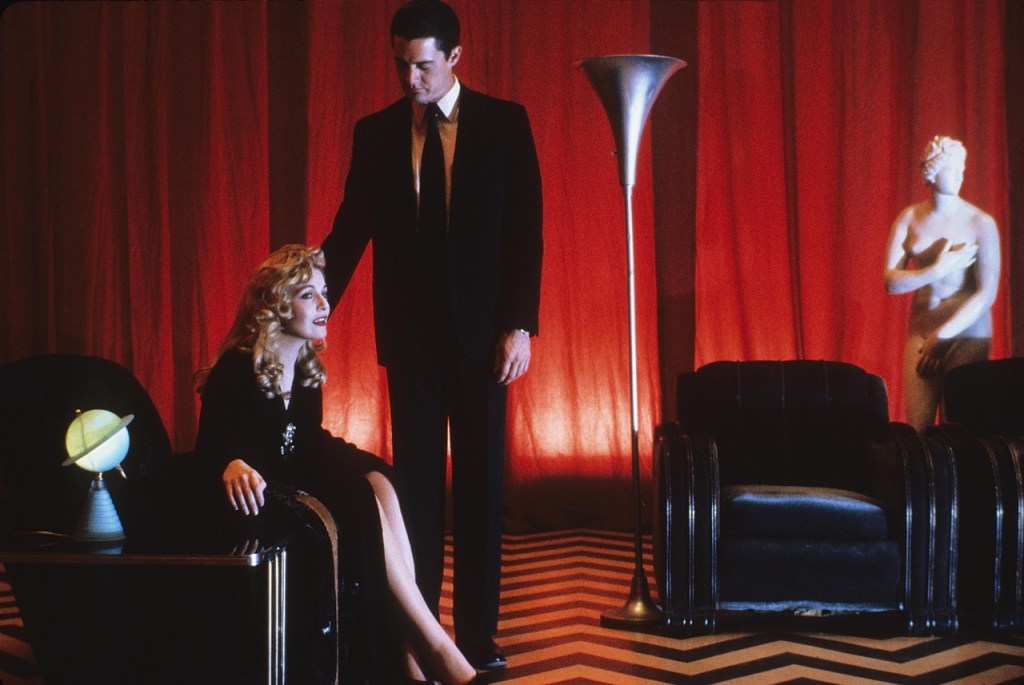
Much of the show is confusing and uncomfortable[13]; melancholy cinematics, themes of death and the supernatural are used to heighten this disturbing tone. These elements are typical of the sublime which is used in Twin Peaks to incite terror in the audience. A notable example of this is in the aftermath of the season 1 finale. Agent Cooper lies injured in his hotel room and is approached by a giant in a surreal encounter that the audience finds difficult to distinguish between reality and hallucination. A second example is the Red Room where Agent Cooper meets Laura Palmer in a psychic dream. The room itself is very sublime; adorned with ceiling high red velvet curtains that, when removed, reveal an “endless black expanse beyond”[14]. Furthermore, Laura speaks in an unusual way, her voice distorted and inhumane, again creating a disturbing atmosphere with a supernatural element. I watched a video and it turns out the actors performed the script backwards and then it was reversed again in post-production.[15]
Other examples include:
- Nosferatu
- Women in Black
- Phantom of the Opera
- Coraline
- Crimson Peak
Horror vs Gothic
As I began researching examples of modern Gothic literature and films, I noticed the lines between Gothic and horror began to blur. Of course, since Gothic incorporates horror, there will be similarities, but I was interested to discover what makes a film Gothic, what makes it Horror and where the line is drawn – if it is at all.
Horror aims to insight a combination of fear and disgust to ‘horrify’ the reader or viewer. This is often done through visceral imagery or gore and sometimes shocks – such as jump scares in films.
Stephen King suggests Horror is a combination of the following three: terror, horror and revulsion. Terror is the anticipation and suspense which precedes a horrific event, horror is the shocked and scared response to the event, and revulsion is the disgusted and nauseated sensation after the use of ‘gore factor’.[16]
“I recognize terror as the finest emotion and so I will try to terrorize the reader. But if I find that I cannot terrify, I will try to horrify, and if I find that I cannot horrify, I’ll go for the gross-out. I’m not proud” – Stephen King[17]
On the other hand, Gothic fiction uses mainly terror. Terror can be held throughout an entire story without a final disturbing event through the use of unsettling characters and setting which is what is often done in a Gothic. It is unlikely for a Gothic novel to use primarily visceral imagery to evoke emotions from a reader – this is more common for a horror. Instead, Gothics rely heavily on atmosphere to create dread, hence films are a great way of presenting Gothic stories because visuals and cinematics can portray atmosphere very successfully. For example, a film like ‘Hostel’ would most certainly be a horror as gory visuals is the primary technique used to scare the audience. On the other hand, ‘The Shining’, although still a horror, could also be described as a Gothic since it revolved around the emotional decline and insanity of a man trapped in an unsettling hotel with his family. Throughout the entire film, the audience is in suspense. Is Jack really going insane? Is the house haunted? Will he hurt his family? This anticipation is very much terror, as defined by Stephen King.
Ann Radcliffe was one of the first to define the differences between terror and horror.[18] She suggested horror intends to scare and horrify the reader or viewer whereas Gothic aims to create anxiety, dread and terror. Some fiction is more clearly defined as Gothic or horror, whist others are a true combination of both. I conclude there is not a fine line between the two and both genres very much overlap. However each genre aims to make the audience feel a different type of emotion.
The Appeal of Gothic
The Gothic genre has been around for a long time, and still inspires countless modern works. So, what makes it so popular?
“Whatever… excite(s) the ideas of pain, and danger, that is to say, whatever is in any sort terrible … is a source of the sublime; it is productive of the strongest emotion which the mind is capable of feeling … When danger or pain press too nearly, they are incapable of giving any delight, and are simply terrible; but at certain distances, and with certain modifications, they may be, and they are delightful.” – Edmund Burke[19]
Burke’s idea of the sublime’s terror inciting a sense of delight can be applied to the Gothic genre. The Gothic has a strong sense of sublime – from great storms to immortal beings – and it is likely these aspects intrigue, excite and appeal to the reader, much like the “delight” Burke referred to.
Many Gothic stories feature things that are out of the known world, meaning time and laws can be tested. The genre offers creative freedom in ways realistic fiction cannot, meaning writers can challenge reality and norms. Because of this, the stories in the Gothic genre create a sense of escape for the reader and or viewer. Escapism is one of the primary motives for reading a story, perhaps a reason for the Gothic genre’s undying popularity. Furthermore, the combination of past and present in older Gothic novels means the time period cannot always be defined and therefore, to modern audiences, narratives are less likely to seem outdated.
Finally, I believe people enjoy being challenged by the Gothic genre and its complicated stories. As it incorporates both horror and romance, Gothics are a way for the reader or audience to feel a sense of terror in a more crafted way. By using atmosphere and suspense, psychological unease and fear can be achieved without the need for visceral, horrifying imagery. In films especially, this means the story isn’t sacrificed for gore factor so often holds deeper meanings. Lastly, the romantic aspect makes for some complex and well written characters since character and their relationships are the driving force in romance novels. This furthers the appeals of the Gothic genre.
[1] Romanticism and the French Revolution. (2010, February 9). Wikipedia, the free encyclopedia. Retrieved May 23, 2020, from https://en.wikipedia.org/wiki/Romanticism_and_the_French_Revolution
[2] Blake, W. (1794). London. In Songs of Innocence and Experience.
[3] John Bowen. (2014, May 15). Gothic motifs. The British Library. https://www.bl.uk/romantics-and-victorians/articles/Gothic-motifs
[4] Burke, E. (1757). A philosophical enquiry into the origin of our ideas of the sublime and beautiful. https://en.wikipedia.org/wiki/Sublime_(literary)
[5] Hirsch, E. (2014). A poet’s glossary. HMH. https://poets.org/glossary/sublime
[6] Field, W. (n.d.). What is the use of supernatural elements in gothic literature? eNotes. https://www.enotes.com/homework-help/what-use-supernatural-elements-gothic-literature-448100
[7] Shelley, M. (1818). Frankenstein: Or, the modern Prometheus.
[8] Glossary of the gothic: Supernatural | Glossary of the gothic | Marquette University. (n.d.). e-Publications@Marquette | Marquette University Research. https://epublications.marquette.edu/gothic_supernatural/
[9] Gothic elements in Harry Potter. (2017, July 24). The Gothic Library. https://www.thegothiclibrary.com/gothic-elements-in-harry-potter/
[10] Analog Drift. (2017, September 20). Black Swan: The Cinematics of Duality [Video]. YouTube. https://www.youtube.com/watch?v=ZfC_vAtZLqo&list=PLdoufpylGAqpKfWUmuz27KFeoObXMEq6c&index=4&t=0s
[11] ‘Black swan’: A dark transformation to the strains of ‘Swan lake’. (2016, August 14). The Mercury News. https://www.google.co.uk/amp/s/www.mercurynews.com/2010/11/29/black-swan-a-dark-transformation-to-the-strains-of-swan-lake/amp/
[12] Murphy, B. (2009). The suburban gothic in American popular culture.
sourced from https://en.wikipedia.org/wiki/Suburban_Gothic
[13] The gothic sublime mystery of twin peaks. (2019, November 7). British Literature 1700-1900, A Course Blog. https://britlitsurvey2.wordpress.com/2019/11/06/the-gothic-sublime-mystery-of-twin-peaks/
[14] Red room. (n.d.). Twin Peaks Wiki. Retrieved June 9, 2020, from https://twinpeaks.fandom.com/wiki/Red_room#cite_note-part2-0
[15] Twin Peaks – Man from another Place teaches how to speak in the Red Room [Video]. (2009, April 25). YouTube. https://www.youtube.com/watch?v=E_q7rZJljKY
[16] King, S. (1981). Stephen King’s danse macabre.
Cited in https://en.wikipedia.org/wiki/Horror_and_terror#cite_note-6
[17] A quote by Stephen King. (n.d.). Goodreads | Meet your next favorite book. https://www.goodreads.com/quotes/17240-i-recognize-terror-as-the-finest-emotion-and-so-i
[18] “On the Supernatural in Poetry” by Ann Radcliffe. (1826). New Monthly Magazine, 16(1), 145-152.
Click to access radcliffe_sup.pdf
Cited in https://en.wikipedia.org/wiki/Horror_and_terror#cite_note-3
[19] Burke, E. (1757). A philosophical enquiry into the origin of our ideas of the sublime and beautiful. http://www.english.upenn.edu/~mgamer/Etexts/burkesublime.html
 Isabel Rose Hay