Socially Charged Representations of Sex and Sexuality in Benedict Andrew’s Cat on a Hot Tin Roof
Isabel Rose Hay, University of Bristol, Film and Theatre BA, Year 1
Introduction to Performance Studies, summative essay, awarded 73/100 first class.
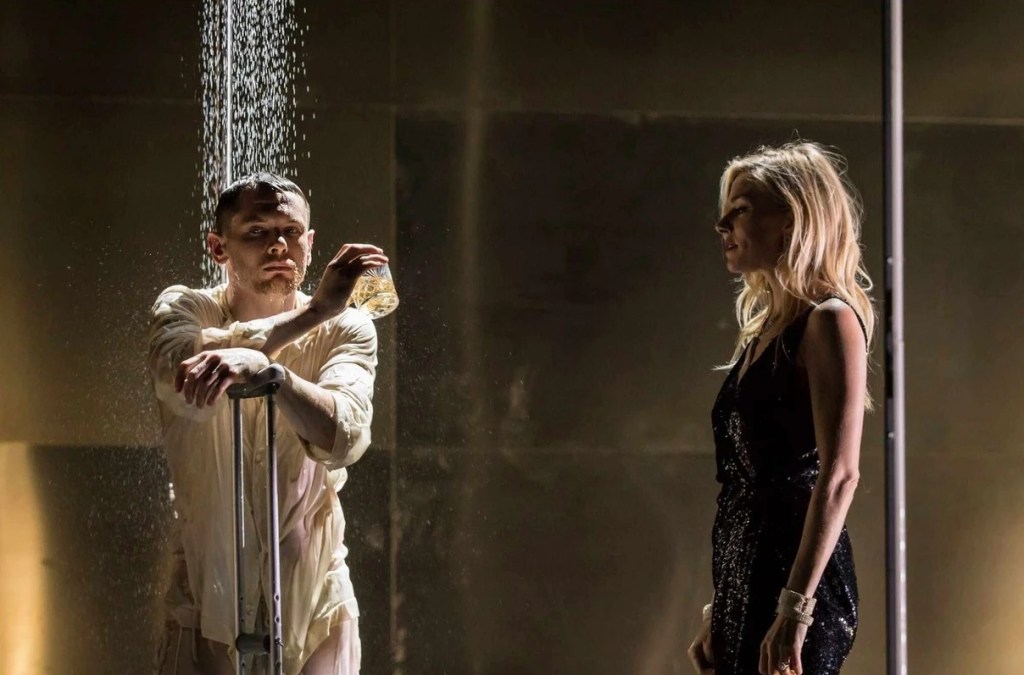
Cat on a Hot Tin Roof by Tennessee Williams, a playwright known for tackling taboo topics in his melodramas, examines the Pollitt family relationship dynamics, particularly of Big Daddy (Colm Meaney), a wealthy plantation owner, his son Brick (Jack O’Connell), and Brick’s wife Maggie (Sienna Miller). The narrative unfolds during Big Daddy’s birthday celebration and tensions build as the family attempts to conceal Big Daddy’s cancer prognosis whilst vying for the family’s inheritance. This is underscored by Maggie and Brick’s strained marriage, which cracks and frays as both characters grapple with internal conflicts, created and enforced by the patriarchal framework and oppressive ideologies in the 1950s American South. Benedict Andrew’s 2017 production divorces the narrative from its Cold War era and propels it into a contemporary landscape, yet the actor’s performances retain echoes of the social, cultural and political period of the original text. This essay explores how performances by O’Connell and Miller encode socially charged representations of sex and sexuality, and how such representations may traverse reception periods.
The play opened in 1955 in the wake of Senator Joseph McCarthy’s ‘fall from grace in 1954’ (Friedman, 2005, pp. 1015), and thus was shaped by the consequences of a period of significant political repression. Johnson (2004) considers a lesser-known product of the anti-communist campaign, the Lavender Scare, a moral panic over homophobia. In 1950, ‘ninety-one homosexuals’ were repudiated from federal employment, considered ‘security risks’ (pp. 1) under the umbrella of ‘sexual perversion’ (pp. 21), thus discrimination was made policy. From the outset of the Cold War, there were concerns regarding homosexuals in Congress so ‘with the rise of McCarthy in 1950, (these) concerns became public and sparked a moral panic’ (pp. 4-5). Friedman (2005) described the use of established homophobia as a ‘political tool (pp. 1106), weaponised to further villainise homosexual individuals. This refracted out of governments and fuelled prejudiced beliefs of the public, concurred by Johnson suggesting ‘the pervasiveness of the homophobia unleashed… affected the behaviour of a wide segment of the population’ (pp. 12) and it was ‘its insidious nature that made it seem such a threat to the nation’ (pp. 12) as ‘fears of Communists and homosexuals overlapped’ (pp. 3). Scholarship on the social and political environment during the original play’s production enables us to understand their influence on subsequent adaptation. Politically repressive ideologies are echoed through the speculation and fears of characters in Cat. In the Southern U.S. setting, existing homophobic cultures were influenced by the Lavender scare and O’Connell’s performance of Brick reflects this.
By channelling Brick’s desperation, denial and vulnerability, O’Connell’s performance captures his inner conflicts regarding sexual identity. Okaura (2013) examines the representation of sexuality in the play within the context of the Cold War, citing Clum’s observation that homosexuality is paradoxically ‘an insistent presence’ and ‘an absence’ due to the censorship on theAmerican and British 1950s stage (Clum, 200, cited in Okaura, 2013, pp. 57-58), such as penalising legislation like Wales Padlock Law prohibiting homosexual representations (pp. 64). Nicolay (2011) relates how queer theorists perceive Brick’s homosexuality as a ‘murky issue’ (pp. 58) which Williams explores through dualities of concealment and revelation in character craftsmanship (Paller, 2005, cited in Nicolay, 2011, pp. 58). Brick’s initially concealed homosexuality is a crucial element in his and Maggie’s strained relationship as it is likely the reason, he refuses physical intimacy. It is a narrative enigma until revelation occurs through insinuations by other characters, notably the pivotal scene during Act 2 when Big Daddy implies a past homosexual relationship between Brick and Skipper. Brick denies this, but his emphasis on a ‘clean friendship’ leads to the question of why such a cleanness must be insisted upon (Okaura, 2013, pp. 59). O’Connell uses gesture to create emphasis, chopping his hands down of the words ‘clean’ and ‘true’, his insistence highlighting the dualistic tension between hidden truths and facades.
Despite performing to modern audiences more accepting of sexual identities, O’Connell’s physical and vocal manifestation of Brick’s distress underscores a fear of repercussions typical of the original context. William’s figurative stage directions ‘Brick is transformed, as if a quiet mountain blew suddenly up in volcanic flame’ guide O’Connell’s furious response. On the line ‘you think so, too? You think so, too? You think me an’ Skipper did, did, did!– sodomy!–together?’, O’Connell raises his voice, spitting through his teeth and losing clarity of diction as he increases vocal pace. He talks over Meaney, flouting the maxim of quantity, driven by shock and worry to deny the suggestion. This lack of vocal composure amplifies Brick’s distress, conveying a fear of social repercussions akin to those during the Lavender Scare when homosexuals were commonly villainised.
Furthermore, O’Connell’s body is held in a high-tension state, only released when he forcefully smashes a glass against the mirror and abandons his crutch to the floor. Griffin (1995 cited in Okaura, 2011, pp. 60) perceives Brick’s injury as ‘a theatrical device to confine all of the action to a single setting’ as well as a tool to emphasise ‘his state of confinement and surveillance as a suspected or hidden homosexual’. Therefore, abandoning his crutch we begin to see his façade crack, both to himself and those around him, as he begins to acknowledge his sexual identity. This dramatic performance also emphasises Brick’s desperation to reject Big Daddy’s suggestions. The physical release of frustration could be symbolic of Brick’s sexual repression and internal conflicts bubbling up within and coming to the surface. During the interaction, O’Connell avoids eye contact with Meaney, emphasising Brick’s attempt at denial. This can be linked to Okaura’s (2013) suggestion that suggests Brick ‘is suffering from an Inescapable hidden homosexual desire on the stage’, supports queer readings of ‘homosexual panic’ (pp. 59), conflicting between his internalised homophobia and homosexual desires (pp. 61). Similarly, Sedgwick (1985, cited in Okaura, 2011, pp.59) theorises that ‘homosocial relationships’ relate to ‘unconscious homosexual desire’ and there is a continuum between the two. The described performative manifestations align with such interpretations of Brick having inner conflicts due to internalised homophobia and closeted sexuality.
Brick’s performance can be read as biblically symbolic, linking his beliefs and prominent Christian ideals. After the line ‘Queers? Is that what you –‘, Brick reaches an emotional breaking point. Without his crutch to lean on, he collapses to the ground in chokes of tears, O’Connell’s catching breath and cracking vocals emphasising his vulnerability and upset. O’Connell kneels with his head pressed to the floor, resembling a prayer pose and perhaps Brick’s plea to banish his homosexual desires, perceiving them as sin; a belief held by many Christians in southern society. This parallels the motif of showering as a sin-purifying act to regain moral cleanliness, which if read through a queer lens, reveals Brick’s belief of homosexuality as perverse. His consequential self-hatred is evident when O’Connell bellows ‘disgust’ spitting out the word as if the thought were something repulsive in his mouth. The Lavender Scare likely contributed significantly to the social conditioning regarding sexual ideologies, cultivating biases and prejudice within the community and plaguing individuals who were grappling with their own queer identities, like Brick.
William’s inclusion of homosexuality would have been controversial due to 1950s theatrical censorship; thus, Brick’s distressed and angry response aligns with the decade’s sexual repression and the political agenda against homosexuals, and the audience would have expected such a reaction. Andrew’s liberal, modern audience may struggle to relate. Had the play stayed true to the original period, Andrews could have sustained audience sympathy, but his choice to contemporise William’s classic dramadiminishes the foundations of the central narrative conflict. By placing the characters in a contemporary setting alongside the audience, the pressures from the original context are lost. Brick is divorced from the period in which he was written and therefore the consequences of his closeted sexuality being revealed lose the gravity they had during the Lavender Scare. Despite this, O’Connell adheres to Brick’s distress in the original script. This highlights that because of how tightly married the script and narrative are to the original contexts, no matter the period performed to or in, representations of gender and sexuality in Cat remain socially charged by the 1950s social and political landscape. Consequentially, the audience may find it challenging to believe in Andrew’s modern setting, despite efforts in modern costuming, prop and set design.
Nicolay (2011) interprets Cat as a parable of ‘the changing American dream and its effects on masculinity, which in turn affects the structure of the family and the lives of women’. In examining Maggie, Nicolay highlights how she navigates the feminine predicament with tactics of ‘pleading, flattering, bullying, insinuating’ through ‘melodramatic performance of femininity’ to initiate sex with Brick (pp. 68-69). Sienna Miller’s performance dominates Act 1 portraying a brazen and sexually frustrated Maggie, who purrs and pounces in desperation for her unrequited lust to be reciprocated. Her desperation to fulfil her sexuality is clear when she stalks on all four across the stage in a cat-like manner, attempting to seduce Brick; her back is arched to accentuate her figure and she elongates her words as if a beckoning temptress. This portrayal of sexuality is theatrical, however, Miller highlights Maggie’s feminine sex elsewhere through more nuanced acting choices. For example, she wears heels and walks with her feet drawing a straight line to emphasise the movement of her hips, she adopts an open-legged posture while sitting on the vanity chair facing the audience, and she maintains a poised and upright posture, often touching her hair in a typically lady-like manner. She exudes confidence, but much of it revolves around her sexuality. Judith Butler (1988) suggests that gender is performative behaviours which represent heteronormative norms of femininity and masculinity not inherent to biological sex. Miller portrays Maggie strategically embodying stereotypical feminine behaviour to achieve two objectives.: firstly, to seduce Brick with her femininity, which ironically might be the reason for Brick’s rejection if he’s attracted to men; secondly, to showcase her value as a woman.
Ryan (2006) explores the mid-1900s and Friedan’s work on ‘The Feminine Mystique’ which theorises that ‘the highest value … for women is the fulfillment of their own femininity’ (Friedan, 1963, cited in Ryan, 2006, pp. 238-239), implying their purpose lies within adhering to gender roles. Panda (2014) observes that Williams uses ‘essentialism’ through ‘binary oppositions’ to ‘sustain sexual difference… between man and woman’ (pp. 49). Dichotomies of love/sex, passivity/activity and barren/fertile allow Williams to thematically explore the interplay of gender and sex, constructing a female world upon ‘the opposition between fertility and barrenness’ (p. 50). O’Connell and Miller’s performances subvert anticipated representations of their sex. O’Connell’s passive portrayal contrasts Maggie’s active pursuit of intimacy, so she can fall on the socially acceptable side of the barren/fertile binary. Once again, the modernisation creates a conflict with the play’s themes since Maggie would not have faced such pressures to become a mother today. Ryan (2016) describes the postwar period also saw a baby boom, with 1950s fertility rates rising to ‘the approximate level of 1900s’, creating extra pressure for women to conceive. Though a generation of modern, working women was on the rise, they accepted ‘the traditional domestic occupations of the female sex’ (pp. 229) with predominant roles of men as breadwinners and women in the sphere of homemaking and childcare (pp. 233). Once again, Maggie’s dilemma lies within a patriarchal framework not so relevant to the modern contexts of the restaging or audience, thus undermining the audience’s ability to emphasise and justify the extent of the conflicts.
In conclusion, Benedict Andrew’s production of Cat, while divorcing the narrative from its original Cold War setting, maintains the essence of Williams’ text. O’Connell’s and Miller’s performances encapsulate and highlight the repressive norms of the era, particularly the struggle with sexual identity and gender roles due to societal pressures. This proves that representations of sex and sexuality in this play are indelibly tethered to the 1950s social and political context.
Bibliography
Cat on a Hot Tin Roof. Tennessee Williams. (2017). Directed by Benedict Andrews, National Theatre. (Apollo Theatre, London. Watched September 2023, online at https://www.dramaonlinelibrary.com/video?docid=do-9781350999046&tocid=do-9781350999046_6146536035001)
Butler, J. (1988). Performative Acts and Gender Constitution: an Essay in Phenomenology and Feminist Theory. Theatre Journal, 40(4), pp.519–531. Available at: https://www.jstor.org/stable/3207893.
Freidman, A., 2005. ‘The Smearing of Joe McCarthy: The Lavender Scare, Gossip, and Cold War Politics.’, American Quarterly, Vol. 57, pp 1005-1110, 1123-1125. Available at: https://www.proquest.com/docview/223307527?accountid=9730
Johnson, DK., 2004, ‘The Lavender Scare: The Cold War Persecution of Gays and Lesbians in the Federal Government’, Chicago: University of Chicago Press, pp. 1-/13-14. Available at: https://ebookcentral.proquest.com/lib/bristol/detail.action?docID=602615.
Nicolay, C., 2011. ‘Hoboes, Sissies, and Breeders: Generations of Discontent in Cat’. The Tennessee Williams Annual Review, Volume 12, pp. 57-73. Available at: https://doi.org/10.2307/45344089.
Okaura, H., 2013. ‘”It’s just like shutting a door and locking it on a house on fire” : Implied Homosexuality and the Representation of the Southern Plantation in Cat’. Studies in English Literature: Regional Branches Combined Issues, Volume 5, pp. 57-65. Available at: https://doi.org/10.20759/elsjregional.5.0_333.
Panda, R.N., 2014. ‘Tennessee Williams’ Cat and Summer and Smoke: A Study in Sexual Difference’, IUP Journal of English Studies, 9(2), pp. 49-53. https://www.proquest.com/docview/1613914453?accountid=9730
Ryan, M.P., 2006, “Mysteries of Sex: Tracing Women and Men Through American History”, University of North Carolina Press, Chapel Hill, pp 227-244. Available at: https://ebookcentral.proquest.com/lib/bristol/reader.action?docID=413410
Williams, T. (2010) Cat. First edn. London: Bloomsbury Publishing (Methuen drama student edition). doi: 10.5040/9781350237926.00000050.
 Isabel Rose Hay