Peaky Blinders: A Contemporary Perspective on Crime Drama and Morality
Isabel Hay, University of Bristol, Film and Theatre BA, Year 1
Close up on TV, summative essay, awarded 80/100 first class.
Steve Neale (1980) asserts that whilst genres are constructed upon repeated conventions, difference is ‘essential to the economy of a genre’ and this is evident through the transformations of crime drama in contemporary television. Pagello (2020) suggests that contemporary European crime drama has ‘abandoned the classic formula… usually focused on the figure of the detective’ (pp. 574) and now focuses on criminal antiheroes, influenced by similar movements in American television such as in The Sopranos (HBO, 1999–2007) (pp.575). Representations of the state have also shifted in crime narratives, allowing for depictions of ‘deep rifts in contemporary society’ which reflect ‘popular disillusionment’ with state authority (pp. 580-81). Peaky Blinders (BBC Two, 2013-2017, BBC One, 2019-2022) is symptomatic of this change in that it capitalises on audience interest in ‘morally ambiguous characters and deep-seated class antagonism’ (Long, 2019, pp.46) through its antihero protagonists, the Shelbys. I will explore how series one of Peaky Blinders transcends traditional crime drama narratives to present a thematically rich depiction of morality.
Thomas Shelby (Cillian Murphy), the central character, is not represented as a traditional hero. Rather, he operates in shades of grey, engaging in morally questionable activities, albeit occasionally driven by ethical motives. In episode 1.2, the Shelby brothers engage in a violent altercation with the Lee family. This iconic moment showcases the brothers wielding the blades in the peak of their hats, from which the gang derives their name. The visual treatment of the scene emphasises their brutal violence by utilising slow-motion to extend the duration of the assaults and their aftermath. Close-ups are also used to tightly frame the characters’ faces and further glorify their injuries and reactions. One particularly uncomfortable moment for viewers is an extreme close-up of John (Joe Cole) forcing blades into his opponent’s mouth, which cuts to a reaction shot of Cole smiling sadistically, revealing John’s cruel tendencies. Low angles are also employed to visually depict the Shelby’s dominance over their adversaries, establishing them as powerful figures to be feared. Furthermore, the use of ‘Blue Veins’ (The Raconteurs, 2006) underscores the visceral nature of the conflict, with gritty guitar riffs and distorted vocalisation evoking a sense of aggression and chaos and paralleling the brutality unfolding on screen. The aesthetic and stylistic choices serve to amplify the violence perpetrated by the Shelbys, subverting audiences’ expectations of traditional, principled protagonists.
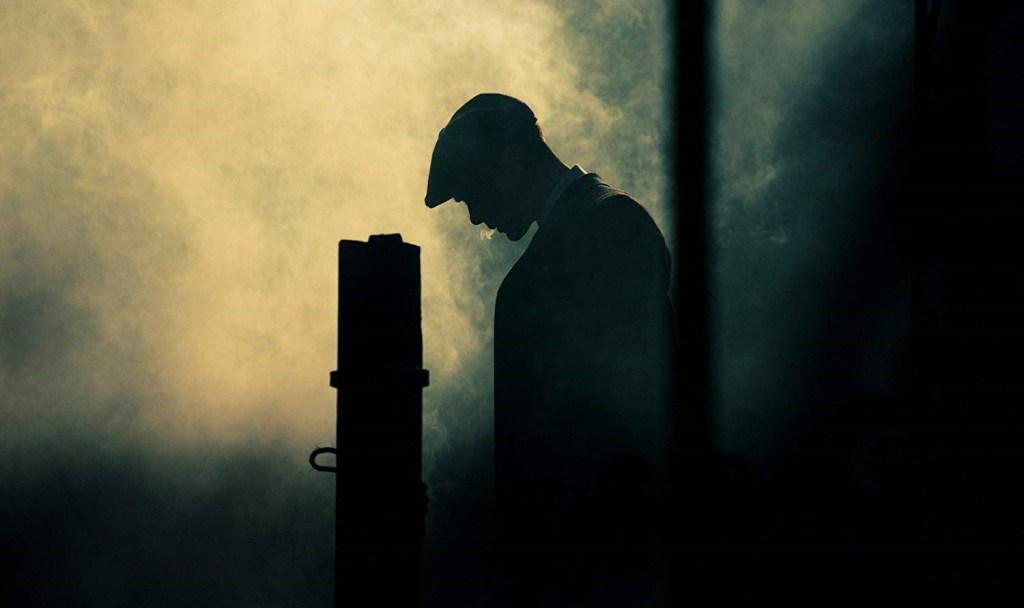
Despite such depictions of immoral behaviour, Peaky Blinders successfully positions audiences’ sympathies with the morally flawed protagonists. Vaage (2015, cited in Long, 2019, pp. 50) explores two factors in gaining an audience’s moral allegiance. First is the ‘familiarity principle’ in which audiences tend to favour characters they are exposed to more frequently. Jimenez-Morales (2016, pp.101) concurs, stating the link between allegiance and alignment is ‘extremely systematic’. The introduction of Thomas in episode 1.1 is relevant to this principle as it adheres to the expectation of the introducing the protagonist first. Stylistic choices immediately establish Thomas as a character of importance and mystery, employing the hermeneutic code to hook the audience. Camera movement fragments Thomas’ reveal, with a vertical pan revealing his legs and then his back. His face, when finally shown in profile, remains partially obscured by his cap, adding to the sense of mystery. Mise-en-scene enhances this enigma with a dreary misty dawn serving as a backdrop to Thomas’ arrival, connoting intrigue and perhaps symbolising the moral ambiguity of Thomas’ world. Thomas’ narrative significance is also suggested through the minimalistic sound design of the foreboding hooves against an eerie silence, which create tension and enhances the impact of his arrival. Thomas’ distinguished attire and increased level on horseback visually separate him from the other characters in the scene, who tip their hats in respect, confirming to the audience this is a man of importance and their protagonist. Throughout the episode, the audience is aligned with Thomas; they often follow his dietic centre and are invited into his private space, such as his bedroom and the family’s betting office. The familiarity principle is facilitated by contemporary crime dramas’ serialised format wherein characters and narratives develop across multiple episodes. As described by Innocenti and Pescatore (2015, cited in 2017, pp.166-167), contemporary quality drama has ‘the appearance of enlarged films distributed across several episodes’. The long form provides more time for the audience to spend with the characters, so they can be immersed in the series’ diegesis. As Thomas’ narrative presence increases, he becomes more familiar and thus more sympathetic to the audience.
Vaage (2015, cited in Long, 2019, pp.54) also asserts that ‘to make the antihero morally preferable, there are always proper villains who are perceived as morally worse’. In the first series, a ‘dichotomous relationship’ (Long, 2019, pp.54) is set up between Thomas Shelby and his antagonist, Inspector Campbell (Sam Neill). Campbell can be seen as an embodiment of the ‘hard-boiled’ detective (Cawelti 1976, cited in Turnbull, 2014, pp27-28), a tough protagonist trope which played a key role in the development of early crime dramas, ‘particularly in the creation of the detective as hero’ (Turnbull, 2014, pp.29). In contrast, Thomas embodies the trope of the gangster. What is interesting in Peaky Blinders is the subversion of the traditional crime drama narrative where the detective fulfils the role of the protagonist, acting as a righteous representative of the state against criminality. Instead, Campbell conducts himself in a manner that is equally, and oftentimes more, immoral than the Shelbys. An example of this is Arthur’s (Paul Anderson) kidnapping, during which Campbell tortures him. The dull and dark colour grading of the scene enhances the visibility of Arthur’s crimson blood on the screen, amplifying Campell’s violence, and extreme close-ups are employed to emphasise the severity of Arthur’s injuries. Furthermore, the staging of the scene, with Arthur dragged into a dimly lit room and Campbell emerging from the shadows, is a recognisable trope of traditional crime fiction. However, Campbell assumes the role of the criminal while Arthur, the gangster, becomes the victim. In the series, both Campbell and Thomas engage in criminality and violence, and thus neither is granted a moral high ground. Subsequently, such violent behaviour does not serve as a basis for moral judgment from the audiences. However, in many of the relationships between Thomas and his rivals, other aspects of Thomas’ character depict him as the lesser of two evils, prompting the audience to place their allegiance with him.
An example of this is Thomas’ treatment of women, which contrasts the behaviour of rival gang member and antagonist, Billy Kimber (Charles Creed-Miles). In episode 1.3, Thomas takes Grace (Annabelle Wallis) to the races and agrees to let Kimber have her for two hours as part of a deal, with Kimber offering his wife in return. Thomas’ hesitancy is revealed through Murphy’s performance; when he breaks the news to Grace, he initially avoids eye contact with her, indicating he is not fully comfortable with the agreement. The subsequent parallel scenes unfolding between Thomas and Kimber’s wife and Kimber and Grace illustrate the juxtaposition in the men’s treatment of women. In the car, Thomas refrains from initiating sexual advances towards Kimber’s wife and converses with her instead. He does not return her eye contact and instead looks towards the house, perhaps hinting at his growing concern for Grace and indicating a moral conflict. Meanwhile, Kimber’s treatment of Grace involves degrading and dehumanising her, such as demanding she pick up a glass for his amusement and using derogatory language like ‘slut’ to address her. The scene reaches its climax when Kimber attempts to assault Grace against the pool table. Fast-paced shots and a discontinuous editing style are employed to depict Kimber undressing Grace and Grace’s struggle, emphasising a sense of distress and urgency. The narrative timing of Thomas interrupting the assault positions him as a saviour and reveals his good conscious winning. Despite Thomas’ initial involvement in the situation, he is now framed as the hero, which serves to redeem him in the eyes of the audience. Kimber’s treatment of Grace reflects his predatory nature, reinforcing patriarchal power dynamics. In contrast, Thomas’ protective instincts over Grace are conveyed. Thomas’ treatment of women is generally characterised by respect, demonstrating a more progressive attitude, especially within the context of the criminal patriarchal society in which he operates. Despite this, even when saving Grace, Thomas does not forsake his deal with Kimber revealing his economic priorities. The continual reframing of characters and their behaviour means morality is ‘constantly in flux’ (Long, 2019, pp.57). Peaky Blinders acknowledges a postmodern ‘scepticism toward… dichotomies and grand narratives’ (pp.61) and applies this to criminality through the absence of a clear moral framework. The narrative destabilises dichotomies of good and bad (pp. 55) and thus presents a depiction of a society where morality is not polarised, and characters operate in the realms of both good and bad.
Jimenez-Morales (2016, pp.101) suggests ‘the more the audience knows the characters, the more they can sympathise with their imagery’ and this is achieved not only through Thomas’ textual presence but also by delving into the emotional depth of his character, particularly his trauma from the First World War. Peaky Blinders is a hybrid of crime and historical drama, and thus historical contexts are significant to the narrative. Johnston, D. (2022) identifies a trend in British drama of Gothicisation, wherein historical trauma confronts its originating society, drawing from Gothic texts depicting the ‘effects of a traumatic past in the narrative present’ (pp.1). Johnston suggests this is achieved through the ‘combination of the specific trauma of the First World War with the ongoing trauma of class struggle’ (pp.1). In episode 1.1, Thomas experiences flashbacks to the war, where temporal cuts between memories in the tunnels and Thomas on his bed exemplify past trauma infiltrating the present. Initially, close-up, slow-motion shots of Thomas smoking opium are used to emphasise his detachment from reality. The pacing increases when the flashbacks begin, which are depicted through quick cuts, handheld camerawork and disjointed images, accompanied by a non-diegetic crescendo string, to reflect the fragmented and disorientating nature of Thomas’ traumatic memories and the increasing tension. Murphy’s portrayal of raw emotion humanises Thomas, adding depth to his character while highlighting the psychological scars he carries from the war. A similar scene unfolds in 1.2 but includes cross-cutting to a conversation between Grace and Campbell as they conspire against Thomas. The framing of Thomas in his room emphasises his isolation with the screen split between the dark wall and the doorway. The doorway offers the audience an entryway into Thomas’ personal space, granting them access to his vulnerability in a way characters within the narrative are not privy to. The darkness beside Thomas creates a sense of abyss, symbolising the depth of his trauma. The scene is dimly lit with atmospheric red lighting creating a surreal ambience, a reflection of Thomas’ mental state. The parallel editing, alternating between the two scenes, juxtaposes Thomas’ personal struggles with the external conflicts unfolding around him and highlights his ignorance of Grace’s inevitable betrayal, revealing a lapse in his usually astute judgements and portraying him as fallible, human and deserving of audience empathy. Including emotional moments for Thomas within the narrative elicits sympathy from the audience and subverts the stereotype of the hardened, immoral gangster.
Depictions of Thomas’ trauma exemplify the Gothicisation of the crime drama as it delves into the horrors of the past rather than presenting the past as utopian. De Groot (2009, cited in Long, 2017, pp.176) suggests Peaky Blinders is an example of dramatic revisionism where the ‘then… is not idealized, but a place of horror; somewhere to escape from rather than nostalgically evoke’. The disillusionment with the past is furthered through the depictions of postwar Birmingham. In episode 1.1, viewers are introduced to the streets of Birmingham through Campbell’s eyes, revealing a landscape plagued by drunkenness, sexual acts and violence, portraying Birmingham as an immoral industrial wasteland. Turnbull (2010, pp.822) suggests crime drama offers ‘a dystopian world characterized by the antithesis to Dyer’s utopian categories’, and this departure from typical entertainment values allows crime dramas to offer social commentary more so than other genres. In Peaky Blinders, depictions of poverty and depravity highlight the social disparities and thus root the violence of our protagonists in the sociocultural context of the time. In reviewing the show, Hanley (2018) suggests that rarely ‘has class struggle formed such a backdrop to a mainstream television show’ and that many of the ‘series’ themes echo the contemporary fears’.
We can return to the dichotomy between Thomas and Campbell to explore how these characters reflect political tensions of the interwar period, which can be connected to contemporary issues in Europe, such as Pagello (2020) linking representations in Peaky Blinders to modern European crisis and populism. Laclau (2005, cited in Pagello, 2020, pp.581) conceptualises populism as the prevailing form of politics in ‘contemporary, late-capitalist society’ with the ideological fight occurring between those ‘in the circles of power and everybody else’, or ‘the people’ versus the economic, political and cultural ‘elites’. Class antagonism and tensions between ‘the people’ and ‘the elites’ is established early in season one of Peaky Blinders; Feddie Thorne’s communist speech pits his working class ‘comrades’ against the upper elites, using the common experience of war to garner support. Meanwhile, Campbell’s emotive speech to the Birmingham police foreshadows ongoing conflict between the Shelby family and the authorities/state. Jimenez-Morales (2016, pp.98) suggests that ‘recent economic crisis’ has challenged the ‘representatives of social leadership and order within society’, and reflections of this societal disillusionment are evident in media such as Peaky Blinders. Employing the antihero gangster, Thomas Shelby, as the protagonist and the police detective, Campbell, as the antagonist subverts traditionally positive representations of the state. Despite its historical setting, Peaky Blinders resonates with contemporary audiences through its reflection of class antagonism and modern distrust towards the state. Pagello (2020, pp.580) suggest ‘the exploration of the State’s absence, inefficiencies, and corruption is as central in the European context as it is in the American one’, maintaining the relevance and marketability of such themes and social concerns for Peaky Blinder’s international distribution. Another notable industrial context is that crime drama narratives could not diversify and explore such social and political tensions when state-controlled companies managed media distribution. The decline in productional hegemony has opened avenues for new voices in the media, as exemplified by Peaky Blinders.
In summary, the evolution of contemporary crime dramas demonstrates a departure from traditional conventions towards a more nuanced exploration of morality and reimagining of authority. Peaky Blinders’ success lies in its ability to align audiences with morally ambiguous antiheroes, integrating contexts to enrich the narrative and humanise its characters. By confronting historical horrors and societal struggles, Peaky Blinders offers a reflection of the past which resonates with contemporary audiences and issues. Ultimately, Peaky Blinders stands as a testament to the evolving landscape of television storytelling, demonstrating the potential of crime drama to offer not only entertainment but also insightful social commentary.
Audiovisual Sources
Peaky Blinders (BBC Two, 2013-2017, BBC One, 2019-2022)
Peaky Blinders, (2013). BBC Two. 12 Sep. Available at: https://www.bbc.co.uk/iplayer/episode/p01fj94w/peaky-blinders-series-1-episode-1
Peaky Blinders, (2013). BBC Two. 19 Sep. Available at: https://www.bbc.co.uk/iplayer/episode/b03bgw2m/peaky-blinders-series-1-episode-2
Peaky Blinders, (2013). BBC Two. 26 Sep. Available at: https://www.bbc.co.uk/iplayer/episode/b03bsw9p/peaky-blinders-series-1-episode-3
The Raconteurs (2006). Blue Veins.
Bibliography
Hanley, B. (2018). ‘THE IRISH IN PEAKY BLINDERS (series 1–4)’. History Ireland, 26(3), pp52-53. Available at: https://www.jstor.org/stable/26565865
Jimenez-Morales, M. (2016). ‘Unfettered Bureaucracy, Narrative Collapse’. McElroy, R Contemporary British Television Crime Drama: Cops on the Box. Routledge, pp 98-109. Available at: https://doi-org.bris.idm.oclc.org/10.4324/9781315573793
Johnston, D. (2022). ‘The Gothicisation of British TV Historical Drama’, Telling Stories: History, Narrative and Fiction. Conference at Queen’s University, Belfast, 15-16th September. Available at: https://doi.org/10.17613/kr5e-1b78
Long, A. (2019). ‘Representing Moral Ambiguity and Class Warfare in Peaky Blinders’. Studies in Popular Culture, 41(2), pp 45-68. Available at: https://www.jstor.org/stable/26644419
Long, P. (2017). ‘Class, Place and History in the Imaginative Landscapes of Peaky Blinders’. Forrest, D and Johnson, B Social Class and Television Drama in Contemporary Britain. London: Palgrave Macmillan, pp 165-178.
Neale, S. (1980). Genre. BFI Publishing.
Pagello, F. (2020). ‘Images of the European Crisis: Populism and Contemporary Crime TV Series’. European Review, 29(5), pp.574–587. Available at: https://doi.org/10.1017/s1062798720001167.
Turnbull, S. (2010). ‘Crime as entertainment: The case of the TV crime drama’. Continuum: Journal of Media & Cultural Studies, 24(6), pp.819–827. Available at https://doi.org/10.1080/10304312.2010.510591.
Turnbull, S. (2014). ‘The Roots of Crime’, in The TV Crime Drama. Edinburgh: Edinburgh University Press, pp20-43. Available at http://www.jstor.org/stable/10.3366/j.ctt1g0b60z.6
 Isabel Rose Hay